Organizational data sovereignty: how an isolated Data Area strengthens GRC, AI, and continuous improvement
In the Brillnet architecture, data sovereignty is more than hosting location. It is an isolated Data Area for your Organization, growing RAG knowledge, and one compliance engine for Pulsar GRC and Crewshift.
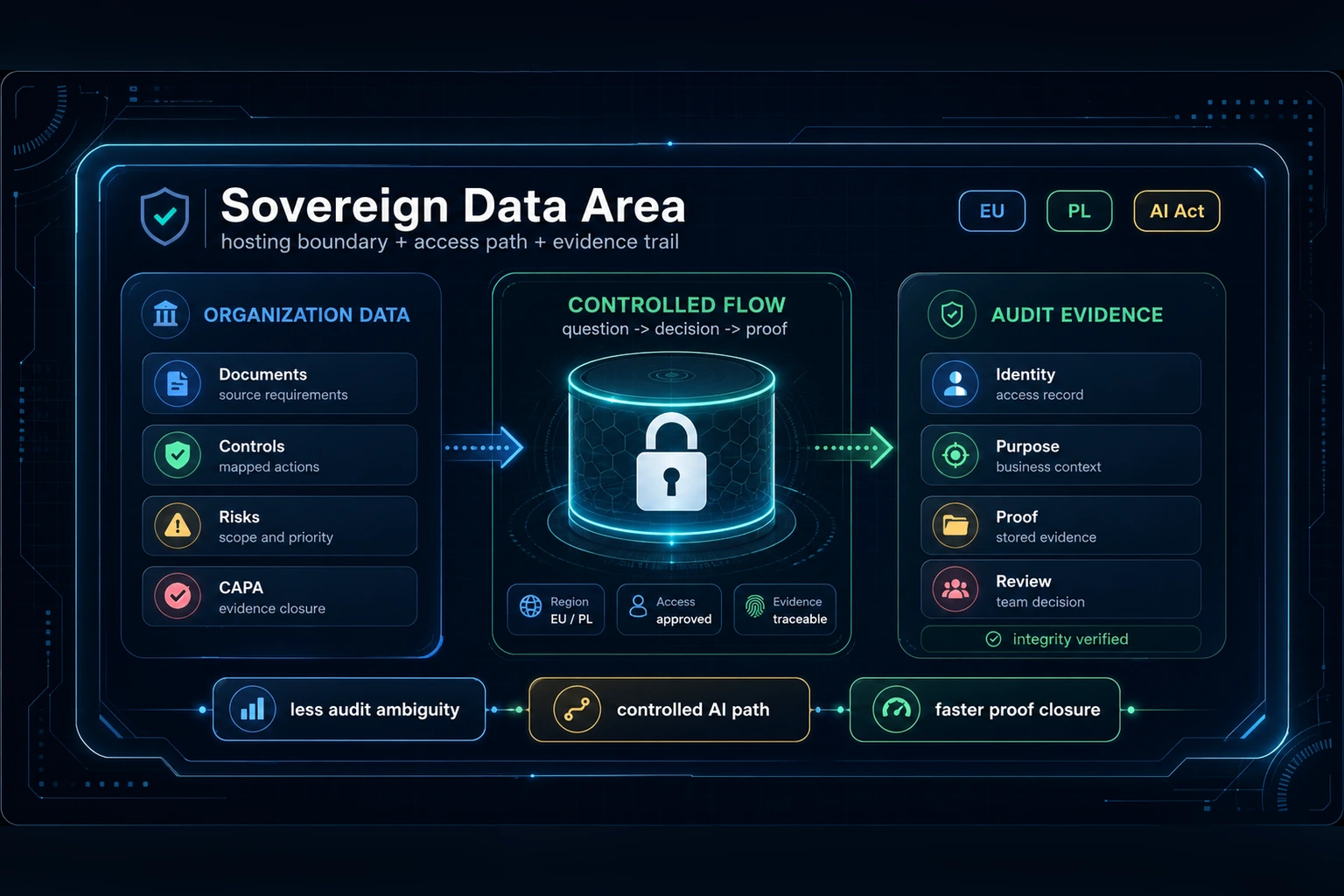
Data sovereignty is an organizational capability
In many companies, data sovereignty becomes a topic only when a customer, auditor, or legal team asks: where is the data, who can access it, and how quickly can you prove it?
Those questions matter, but they come too late if the Organization treats data sovereignty only as a security policy statement. In practice, it is an operational capability: the way a company stores documents, builds evidence, uses AI, and learns from each audit cycle.
In the Brillnet architecture, this capability is designed around four elements:
- an isolated Data Area for your Organization,
- Pulsar GRC as the platform for documents, requirements, controls, risks, audits, CAPA, and evidence,
- Crewshift as a separate application for training, acknowledgements, competencies, and TTX workshops,
- the shared Brillnet compliance engine, which provides regulatory context and AI designed for human oversight, decision traceability, and controlled use in both products.
The result is not that the system “has AI”. The result is that the Organization starts building its own compliance and operational memory.
The isolated Data Area is the starting point
In a typical SaaS setup, customer data is placed in a shared application layer, while isolation is described mainly through roles, permissions, and a tenant identifier. That is still necessary, but often not enough in regulated environments.
The Brillnet architecture goes further: the Organization’s domain data is assigned to its own tenant stack, a dedicated runtime area for database, storage, cache, and RAG. In practice, documents, evidence, artifacts, and the Organization’s knowledge are not treated as an anonymous part of one shared data pool.
This separation creates value that is easy to explain outside IT:
- it is easier to explain where the Organization’s data is located,
- the boundary between customers is easier to prove,
- backup, retention, and export planning become clearer,
- AI can be used more safely on the Organization’s documents,
- conversations with enterprise customers, auditors, and procurement teams become more precise.
This is not an infrastructure detail. It is the trust foundation for the whole GRC process.
Knowledge that accumulates instead of disappearing after an audit
In many Organizations, every audit starts almost from scratch. The team looks for current procedures, reconstructs decisions from email, collects evidence from folders, and tries to remember why a previous action was accepted as sufficient.
Pulsar GRC changes that model by structuring the flow:
Documents -> Requirements -> Controls -> Risks -> Audits -> CAPA -> Evidence
When the Organization adds documents, procedures, legal requirements, audit results, and evidence, the system does more than store files. It builds the Organization’s knowledge context. This context accumulates in the RAG layer, so later analyses can use prior work, cite sources, and guide the Quality/Compliance Manager toward the right questions more quickly.
This is a practical form of continuous improvement. Not a slogan in a presentation, but a working loop:
- The Organization imports its own documents and requirements.
- Pulsar GRC helps build the Coverage Graph and Gap Analysis.
- The team makes decisions, assigns actions, and closes evidence.
- Crewshift can take over training, acknowledgements, competencies, or TTX workshops.
- Results come back as knowledge and evidence that make the next review easier.
The Organization does not lose knowledge when the audit closes. Every next cycle starts from a better position.
One compliance engine, two applications
Pulsar GRC and Crewshift use the same Brillnet compliance engine, but they solve different problems.
Pulsar GRC structures the compliance area: documents, requirements, controls, risks, audits, CAPA actions, evidence, the Coverage Graph, and Gap Analysis.
Crewshift structures the people and change adoption area: training, acknowledgements, knowledge checks, competencies, rollout campaigns, and TTX workshops. If Gap Analysis shows that a team needs training or a scenario needs to be exercised, Crewshift is the right application for that part of the work.
The shared compliance engine means the two products do not create two separate stories. The Organization can see the relationship between a requirement, an action, evidence, and the team’s capability.
Regulatory context without taking decisions away from the Organization
The Brillnet compliance engine can use regulatory context and legal-source integrations at the core level. This layer adds knowledge about legal changes and their relationships into RAG. As a result, AI support in Pulsar GRC and Crewshift can better understand the regulatory environment in which the Organization works.
The boundary is deliberate: Brillnet does not sell standards content or ready-made requirement catalogues. Standards, procedures, and requirements relevant to your sovereign Data Area are supplied by your Organization. Pulsar GRC maps them inside the isolated Data Area and helps produce the Coverage Graph and Gap Analysis. Decisions on acceptance, priority, and closure always stay with your Team and your Organization.
This matters because AI should support the process, not replace the Organization’s responsibility.
What the Organization gains
1. A shorter path from question to evidence
When a customer asks about a requirement, control, or corrective action status, the team does not start by searching inboxes and folders. It has a flow in which the document, decision, owner, action, and evidence are connected.
2. More value from every iteration
RAG inside the Organization’s Data Area is not a one-off add-on. Over time, it collects context from procedures, decisions, evidence, gaps, and actions. This allows later reviews to start from knowledge the Organization has already built.
3. Safer AI adoption
AI support works on data in a controlled context. AI helps analyze, structure, and suggest next steps, but final operational, quality, and compliance decisions stay with your Team.
4. Fewer silos between compliance and people
Pulsar GRC shows what must be met and proven. Crewshift helps bring the change to people through training, acknowledgements, competencies, and exercises. This closes the gap between a document and real operational behavior.
5. A stronger enterprise customer conversation
Data sovereignty, an isolated Data Area, and a consistent evidence trail make it easier to answer questions about security, access, retention, AI, and audit readiness. The sales or implementation team does not have to improvise answers.
When this becomes urgent
Most often, this happens when:
- an enterprise customer asks about data isolation and access paths,
- the Organization wants to use AI in regulated processes,
- an audit requires a quick link between requirement, control, and evidence,
- a legal change requires an impact assessment across procedures, training, and ownership,
- compliance knowledge is spread across people, folders, and spreadsheets.
If a simple question takes several days of material collection, the issue is not only compliance. It is the Organization’s operational memory.
Summary
Data sovereignty creates the most value when it becomes part of daily work. In the Brillnet architecture, this means an isolated Data Area for your Organization, growing RAG knowledge, a shared compliance engine, and cooperation between Pulsar GRC and Crewshift.
This approach helps move from “we collect evidence before the audit” to “we build evidence and knowledge as work happens”. This is where real continuous improvement appears: every decision, gap, action, and evidence item can increase the value of the next compliance cycle.